Bach: St. Matthew Passion

Worcester Chorus, with The All Saints Church Girl & Boy Choirs and The Choristers of the Trinity Lutheran Church, Guest Soloists; Festival Orchestra; Andrew Clark, Music Director

Saturday, March 7, 2009
Mechanics Hall - 8:00 P. M.

Overview

andrew-clark.jpg

<!--[if gte mso 9]> Normal 0 false false false MicrosoftInternetExplorer4 <![endif]--><!--[if gte mso 9]> <![endif]--><!--[if gte mso 10]> <![endif]--> Once described as a “majestic cathedral of music” Bach’s St. Matthew Passion stands as one of the pillars of Western music, it is at once monumental and intimate, and emotional journey of anguish and hope, eloquent and forceful, an experience of tremendous impact and drama - a perfect offering for this season. Music Worcester presents this epic work for the first Worcester performance in many years, promising to be a major highlight of the concert season.

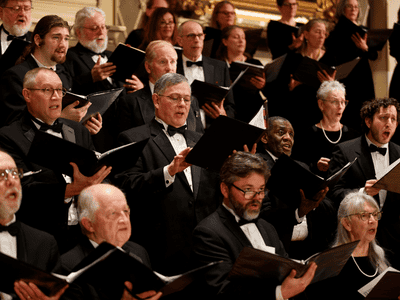
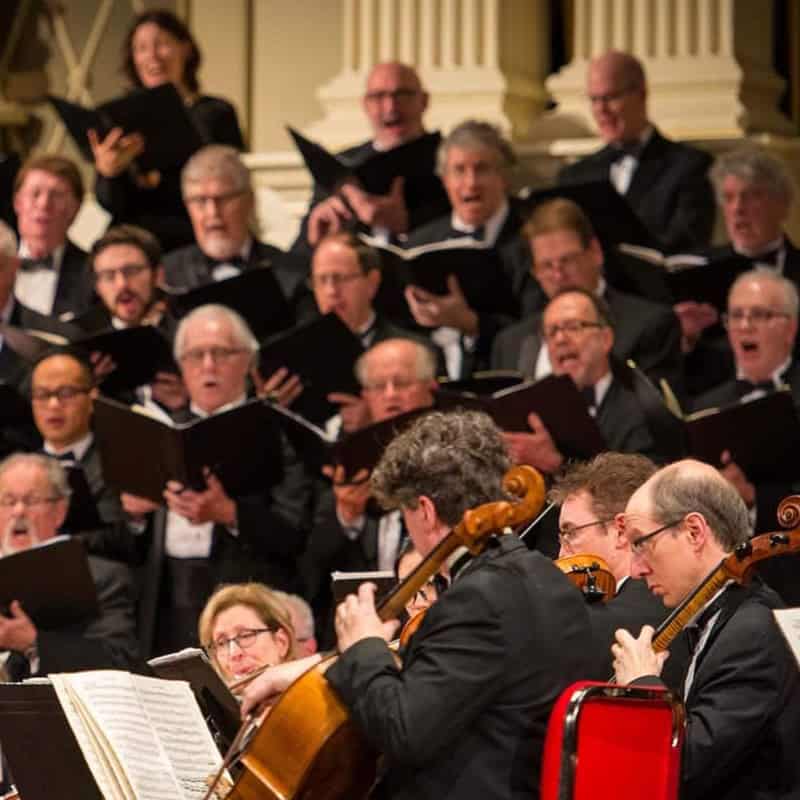
Joining the 100+ voices of The Worcester Chorus will be the very accomplished All Saints Church Girl and Boy Choir and the Choristers of the Trinity Lutheran Church - both from Worcester, a chamber orchestra and some of our country’s finest Bach soloists.


This project was funded in part by a grant from Greater Worcester Community Foundation." 

“There is nothing like it, in all music”

– Leonard Bernstein

Related Sites

Program

JOHANN SEBASTIAN BACH (1685-1750)
St. Matthew Passion, BWV 244
The word "passion" as applied to a musical genre is derived from the Latin patior, "to suffer." A long musical tradition extending from the late Middle Ages through Bach's time called for a musical treatment of the Gospel accounts of Jesus' suffering from the moment of his arrest in the Garden of Gethsemane to his death on the cross. These were performed in services during the day on Good Friday-traditionally at the same time when Jesus was suffering on the cross. The texts and the music end with the laying of his body into the tomb. The somber effect of this text and its setting served as a potent dramatic preparation for the joyous brilliance of the music that would burst forth early in the morning of the ensuing Sunday, Easter, to celebrate the Resurrection.
Both of Bach's surviving Passion settings have somewhat tangled histories. The St. John Passion is particularly complex; Bach rewrote it several times, and it is hard to tell exactly what music was supposed to be included in any given version. The St. Matthew Passion, more unified in concept and in compositional history, stands at the summit of Bach's output for the Protestant Christian church service. It is his most elaborate and most demanding score, the longest in running time, and the largest in performing forces required. Bach laid out the entire score for two separate choirs and orchestras. Throughout the score he carefully indicated whether any given passage is intended for "Choir I" (the term "choir" meant a group of musicians, vocal and instrumental, not-as in modern practice-singers only) or "Choir II," or all the forces combined. For a long time it was believed that the work was premiered on Good Friday (April 15) 1729; certainly Bach gave a performance of the St. Matthew Passion on that day. But recent evidence supports the inference that the 1729 performance was a revival. The only other available date--that is, the only Good Friday for which we do not know what Passion setting Bach conducted-is April 11, 1727. All in all, the earlier date seems the most probable.
In any case, there is no doubt that Bach regarded the St. Matthew Passion as a work of special importance. For one thing, he made a careful fair copy of the full score, something that virtually never happened unless he was preparing to make a formal presentation of a beautiful manuscript to a potential patron (such as the Margrave of Brandenburg, who thus received an exquisite copy of the concertos that have immortalized his name) or because the work was for a soloist on the harpsichord, organ, or solo violin who required a clean copy because they would play directly from the manuscript.
For larger works, Bach's full score was usually a final draft copy, often filled with afterthoughts and corrections; these did not matter as long as the players had clear accurate parts to play from. Yet Bach went to the extraordinary effort of writing out a fresh copy of the entire score of the St. Matthew Passion-and in two colors of ink, his normal dark-brown for the staff lines, the music, the chorales and the arias, and red for the words drawn from the Bible. And when, at a later time, the opening pages became damaged, he repaired them, carefully pasting blank paper over the damaged part and rewriting the missing notes. All this effort indicates that this score meant far more to him than the simple fulfillment of a clause in his contract.
In two important respects Bach's Passion settings were regarded as conservative, even old-fashioned, for their day, yet both respects have made them stronger for modern listeners. First, he retained the actual Biblical text to tell the story (expanded with passages of meditative reflection for the ariosos and arias.) Other Passion settings of his day used stilted poetic paraphrases, but the original Gospel account is vastly stronger as a narrative. Second, Bach, almost alone among composers of his time, retained a fondness for the texts and the melodies of the Lutheran chorale, the communal congregational song that had always been the backbone of Protestant music. His imaginative reharmonizations of the chorales, which the congregation could be expected to know by heart, illumined the meaning of the words. The flexibility and variety of Bach's harmony is always a marvel. The St. Matthew Passion is a particularly striking illustration of Bach's art, since one chorale melody, O Haupt voll Blut und Wunden, appears in no fewer than five harmonizations, each superbly suited to the dramatic context and the specific stanza used at that moment.
The narrative text comes from chapters 26 and 27 of the Gospel according to Matthew. But the bulk of the music in the Passion sets the poetry of Christian Friedrich Henrici (1700-1764), who wrote under the pen name Picander. A sometime author of scurrilous and erotic verse, later an official in the postal service, Henrici became Bach's most frequent textual collaborator. He published the poems that form part of the St. Matthew Passion in 1729 in the second part of his Ernst-scherzhafte und satyrische Gedichte (Serious, comic, and satirical poems). This did not include the Biblical passages or the chorale stanzas that form so much of the Passion text; it is possible, and even likely, that Bach prepared an outline of the entire work, breaking the Biblical text down into component scenes, choosing the chorale stanzas, and commissioning from Henrici the poetry for the ariosos and arias, possibly even suggesting the image or metaphor that he wanted for his musical purposes. If this is what happened, the layout is as much Bach's work as Henrici's.
From all the diverse elements-dramatic recitative, expressive arioso, reflective aria, chorus, and chorale--Bach constructed the score as a mosaic of different textures and sonorities. The thread that runs throughout is the Gospel story, broken up into individual "scenes" and related in light, rapid recitative. Bach paid careful attention to the declamation of words and provided imaginative-even daring-harmonic underpinning to shade the sense of each phrase, each significant word. The scenes in recitative are the heart of the Passion, a direct link to the manner in which the tale has been re-enacted liturgically for centuries.
It is appropriate for the Biblical text to play a major role in the score of a Lutheran composer. Luther himself emphasized the central significance of Scripture and the importance of preaching the Word. In fact, everything in Bach's score may be considered a response to Luther's injunction: just as the pastor of the church takes a Biblical verse as his sermon text, so the composer of the Passion first depicts the tale dramatically, then interprets the reaction of the individual believer in the arias, and finally offers the reaction of the entire community in the chorales. Rhythm, harmony, melody, and orchestral color are at the service of the text, providing an exegesis phrase by phrase, even word by word.
Often the Biblical passage invites the worshipper's participation. To take a single example: No sooner do the troubled disciples, warned that "one of you shall betray me," ask, "Lord, is it I?" than all of Christendom, represented by the simple chorale, replies, "It is I that should atone, bound in hell by hand and foot; the scourging and the bonds and everything you endured-it was my soul that deserved it." In this way, at every point, Bach brings home to the listener, with intense conviction and dramatic power, the theological significance of the dramatic scene.
The Passion as a whole is divided into two parts, with a break in between. In Bach's day the break was not an intermission (such as we employ for concert performances today) but rather the place for an hour-long sermon, which offered yet another explanation of the scriptural text and its application in the lives of the congregants, to be followed directly by the second half of the composition. Part I ends after Jesus has been arrested; the final Gospel text to be included before the break is: "Then the disciples all deserted him and ran away." (There is, of course, the interpretive chorus-the chorale "O Man, bewail thy grievous sin," addressed to all of humanity, a text that is positively chilling here-before the actual end of Part I). The second part then comprises the entire story of the scourging and execution of Jesus from Matthew 26:57 to the end of the following chapter.
In addition to the dramatic framework provided by the Biblical story, Bach opens and closes each part with a large musical set-piece to anchor the action. The opening of the first part is one of the most brilliantly conceived passages in all of music. Bach opens dramatically in the middle of the story, imaginatively depicting the slow and painful procession in which Jesus carries his cross to Calvary. The orchestra plays a dragging, halting march rooted to its somber E-minor. The choruses represent the crowds in the street calling to one another to come and witness the sight. Precisely at the moment when the choirs sing "Behold him!-How?-Like a lamb," Bach adds on top of everything the chorale melody O Lamm Gottes unschuldig (O innocent Lamb of God) sung by the boys' choir.
This immense opening chorus is both a dramatic foreshadowing of events to come and a commentary on those events. If there were no text at all, it would be called a chorale prelude, one of many examples (usually for organ) in which Bach interprets the significance of a chorale melody with an elaborate musical setting. Thus the opening chorus suggests by its size the immense scope of the work to follow while at the same time giving a taste of its expressive power and offering a theological interpretation, all the while working into the story a particularly striking dramatic element-the procession to Calvary-that is treated very briefly in Matthew's telling. Has any work's opening movement ever served more simultaneous functions with such expressive and technical success?
Following the opening chorus Bach leaps at once into the drama. The Evangelist (representing the author Matthew himself) recites the narrative of the story, while individual singers take on the roles of the characters who have spoken dialogue-Jesus, Peter, Judas, Pilate, Pilate's Wife, and all the others. Their dialogue is dramatic, sung in recitative that could come straight from an opera. Indeed, no Baroque composer surpassed Bach in the powerful thrust of his recitatives, which reveal character and move the story along through melody that crisply shapes the language at breathtaking speed over daring harmonizations. Yet owing to the circumstances of his life, trapped in a musical backwater, Bach never had occasion to compose a work for the theater. The battleground of the human soul was his stage; the St. Matthew Passion is his greatest opera.
One special feature of the recitative in the St. Matthew Passion was taken by Bach from a tradition that goes back at least as far as Heinrich Schütz a century earlier: the words of Jesus, unlike all the other dialogue in the story, are accompanied by the strings. In the nineteenth century this device came to be called a "halo." It appears throughout the work, every time Jesus sings, except in his last utterance, "Eli, eli lama sabachthani," at the moment of his death. This one purposeful omission of the string accompaniment generates a powerful sense of mortality.
Virtually every scene in this "opera" ends with the requisite aria, just as the operas of Scarlatti or Handel might. But in this case, the audience has witnessed in recitative a scene from the familiar story. As it ends, a soloist who is not part of the scene, but an outside commentator (like the members of the audience themselves) utters a personal reaction to the drama just witnessed. In almost every case, this takes the form of an elaborate accompanied recitative or arioso that leads into a full Da capo aria. Bach generally cast these in the form of a duet between the solo voice and an instrument (or sometimes a pair of instruments playing together). The choice of solo instrument varies from aria to aria; it is a vital part of the expression, since the instrument presents the basic musical material of the aria before the voice enters and thus establishes the fundamental "affect," or emotional tone, of the number.
Occasionally, too, the instrument serves a pictorial function. A good example can be found in the first arioso-aria pair of the Passion: the alto soloist (no doubt chosen here to symbolize the woman who has just anointed Jesus' head with the oil) is accompanied by two flutes and continuo. In the arioso Du lieber Heiland, du, the flutes play a pattern of four descending sixteenth notes that provides rhythmic momentum while serving as a musical emblem of sorrow at the "foolish arguments" of the disciples over the woman's action. The aria continues in the same mood, with the soloist asking that her tears of penitence could serve equally well to anoint Jesus as the woman has just done. Again the two flutes symbolize the mood of remorse with a melodic motive that keeps moving downward in an expression of humility; but in the middle section of the aria, when the alto sings of her "teardrops," the flutes become purely pictorial, echoing one another in staccato "drops" falling from above. Bach's art concretely links psychological mood to physical reality again and again throughout the Passion.
In Part II, the story races ahead, recounting, in vivid detail, the interrogation, the scourging, and the execution of Jesus. Pilate finds no evil in him and offers to release him as an act of mercy at Passover time, but the crowd, in dissonant, hammering chords, cry out that they want Barabbas released instead. As in Part I, each fragment of the story is interpreted at once for the audience. When Pilate asks, "What evil has he done you?" the tenor immediately responds in an arioso "He has done good to us all," and then continues with the aria, "For love will my savior die."
Finally, after the body of Jesus has been given over to Joseph of Arimathea for burial and Pilate has posted his guard at the tomb, the chorus ends the Passion with one more set-piece, a gentle and subdued final lullaby closing with the words "Gently rest." This consoling music, suggesting only a going to sleep, is for Bach and his congregation the suitable conclusion to the horrors of the crucifixion. They know that Good Friday, which ends in darkness and despair for the disciples, will be followed by Easter morning. The catharsis of grief that has been expressed here will be changed to great joy; in the meantime they must ponder on the message of the powerful drama they have witnessed on this Friday afternoon.

© Steven Ledbetter (www.stevenledbetter.com)


About the Artists

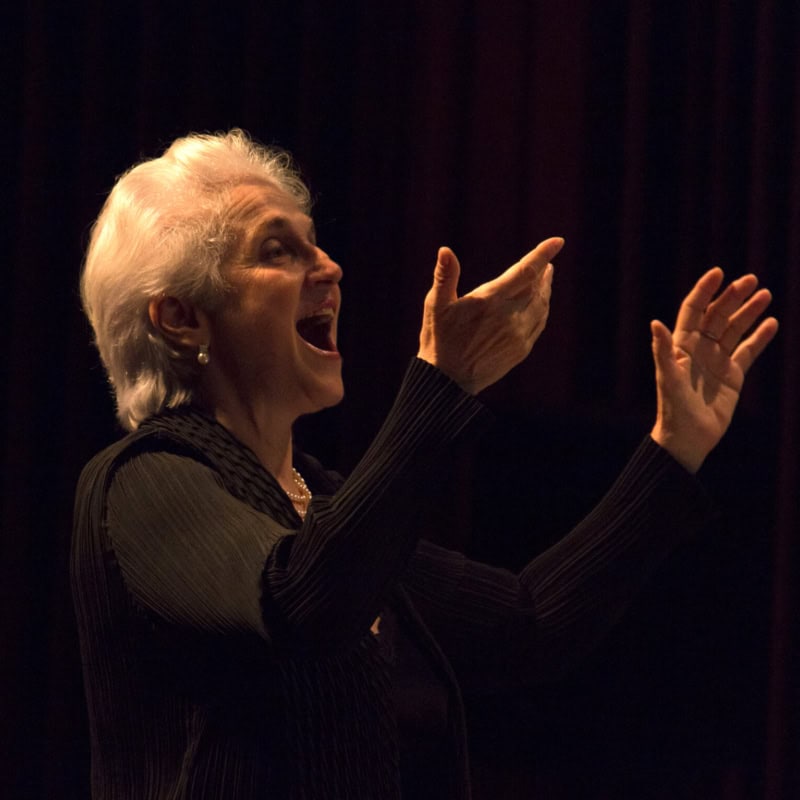
Andrew Clark has been recognized by Chorus America as one of our country's most promising young conductors, leading performances praised for their "tremendous invigoration", as "cohesive and exciting", "amazingly polished" and "enjoying tremendous rapport, respect, trust and affection with his singers" [Boston Globe, Providence Journal, Worcester Telegram & Gazette]. In his sixth year as Director of Choral Activities at Tufts University (Medford, MA), Clark also serves as the Artistic Director of the Providence Singers and Music Director of the Worcester Chorus, two of the largest and most celebrated choral arts organizations in New England.

An advocate for the music of our time, Mr. Clark has commissioned numerous composers, presented over twenty world premieres, and conducted important contemporary and rarely heard pieces in addition to many performances of well-known choral-orchestral masterworks.

Mr. Clark has collaborated with renowned organizations including the Kronos Quartet, Pittsburgh Symphony Boston Pops, Rhode Island Philharmonic, New Haven Symphony, Newport Baroque Orchestra, , Opera Boston, Boston Children's Chorus, and the Newport Jazz Festival, working closely with Dave Brubeck, conductors Mariss Jansons, Neville Marriner, Helmuth Rilling, Keith Lockhart, Larry Rachleff, Gil Rose and others. He has appeared at prestigious venues including Carnegie Hall, Lincoln Center, Cathédrale Notre Dame de Paris, Mechanics Hall and in Vienna, Budapest, Madrid, Seville, Sorrento, St. Petersburg, Montreal and throughout the United States.

A supporter and advocate for music education, Clark serves as a distinguished faculty member of the "Notes from the Heart" Music Camp in Pittsburgh, a summer music program for children with disabilities and chronic illness supported by the Pittsburgh Symphony Orchestra and the Woodlands Foundation. He was the founding Music Director of the Junior Providence Singers, a high school choral education ensemble sponsored by the Rhode Island Philharmonic Music School and Providence Singers.

Clark received degrees from Wake Forest and Carnegie Mellon Universities, having studied with Grammy-award winning conductor Robert Page, as well as Jameson Marvin, Dale Warland, Vance George, Brian Gorelick, David Effron, Gunther Schuller, William Weinert and others. He previously served on the conducting staff of Harvard and Clark Universities and as assistant conductor of the Mendelssohn Choir of Pittsburgh and the Boston Pops Holiday Chorus. He is a member of the national music honor society, Pi Kappa Lambda.

The Worcester Chorus and Festival Orchestra- see The Worcester Chorus page on this web site for more information on the chorus.

Charles Blandy, Evangelist
Steven Small, Jesus
Elizabeth Weigle, soprano
Pamela Dellal, alto
Dimitrie Lazich, baritone
Thomas Jones, baritone


The All Saints Church Girl & Boy Choirs


The Choristers of the Trinity Lutheran Church: 
Benjamin Blodgett, Celeste Blodgett, Madeleine Blodgett, Alivia Burns, Alanna Doyle,Liam Doyle, Andrew Gingras, Molly Greer, Sophie Greer, Melissa Mello, Johanna Okerlund, Luke Okerlund, Brendan Olson, Arden Reinhardt, Kylee Scanlon.


Soprano Elizabeth Weigle is sought out for her unique vocal beauty and interpretive insight, which she lends to music ranging from the Baroque to the 21st Century. During the 2008-2009 season she performs Handel's Messiah at both Carnegie Hall and Washington National Cathedral, McCartney's Ecce Cor Meum at Allentown Symphony Hall, Bach's St. Matthew Passion at Mechanics Hall, Bach's St. John Passion at Washington National Cathedral, Handel's Alexander's Feast in Sacramento, Carmina Burana at Dickinson College, recitals with guitarist Daniel Lippel at Wesley College, recitals with pianist Gilya Hodos and Allen Krantz in Philadelphia, and Gounod's St. Cecilia Mass in Westerly, RI. Elizabeth is featured on three recordings by 20th century American composers to be released this season: Lucas Foss' The Prairie; Holmes' Three Hunting Songs; and the very first recording of Morton Feldman's Rabbi Akkiba.

Highlights of Elizabeth's past performances include: Mahler's Symphony Number Four with Colorado Symphony (Andrew Litton conducting), World Premiere-Shende's Three Longfellow Poems (written for her) with Portland Symphony, American premiere of Chen's Voice of Pines and Cedars at Carnegie Hall with BMOP (Albany Records), Oliver Knussens' Hums and Songs of Winnie the Pooh at Carnegie Hall and Tanglewood, Bach's Cantata 51 Jauchzet Gott with American Bach Soloists in San Francisco, Pat Nixon (Nixon in China) with Opera Boston, and Despina and Sophie (Der Rosenkavalier) with Chautauqua Opera.
A graduate of the Eastman School of Music where she studied with the late Jan DeGaetani, Elizabeth earned her MM at the Manhattan School of Music with continued studies at the Juilliard School. She is a winner of a Sullivan Foundation award for outstanding performances, as well as as fellowships to the Aspen, Tanglewood, Chautauqua and Carmel Bach Festivals and has recorded for the Nonesuch, Erato, Albany and Koch labels. Elizabeth lives with her husband and two cats in Philadelphia, where she teaches voice at St. Joseph's University and at her private studio.


Biographical information for: Steven Small, Baritone
Steven Small has been critically hailed as one of New Englands outstanding soloists and has enjoyed a distinguished career in opera oratorio and recital throughout New England and beyond. A lyric baritone, Small has been acclaimed for the beauty and flexibility of his voice, as well as his dramatic and interpretive capacity. He made his professional debut in the role of Mendelssohns Elijah. A noted interpreter of Baroque music, Small's repertoire also includes many 20th century and contemporary works.  Recently he has performed the Brahms Requiem, Messiah, St Paul and the American premiere of Requiem by Jonas Kokkonen. The current season includes: Dona Nobis Pacem of Ralph Vaughn Williams, Handels Messiah, this performance of the St. Matthew Passion of Bach, Sir Michael Tippets , A Child of our Time and Haydn'sThe Creation. Small is a voice student of Hazel ODonnell. He serves as the Senior Pastor of the First Congregational Church, United Church of Christ in West Boylston, Massachusetts.


Dimitrie Lazich, lyric baritone, is a graduate of the Curtis Institute of Music. He has performed leading roles in Die Zauberflote, Le Nozze di Figaro, The Rake's Progress, La Boheme, Die Fledermaus, among many others.
Mr. Lazich has also performed leading roles with the Opera Theater of Pittsburgh in Candide and Louis in their production of Bolcolm's A View from the Bridge. With the Opera Company of Philadelphia, he has performed Marullo in Rigoletto, Wagner in Faust as well as Lakai in their production of Ariadne auf Naxos. He has also been heard as Erste Soldat with the Cleveland Opera in Salome, and with De Nederlandse Reisopera as Marchese d'Obigny in La Traviata. A part of the Opera Studio Nederland in 2000-01 he performed the roles of Falke in Die Fledermaus as well as Junius in The Rape of Lucretia.
Mr. Lazich made his professional European debut with the Staatsoper Stuttgart singing in their production of Dr. Faustus. He has also performed several times as part of The Music Academy of the
West where he performed Beaupertuis in Il cappello di paglia di Firenze, Guglielmo in Cosi fan tutte, as well as Don Alvaro in Il Viaggio a Reims where he worked closely with Ms. Marylin Horne and the late Randal Behr.
Most recently Dimitrie Lazich made his English debut with Dorset Opera singing Zurga in their production of Les pêcheurs de perles. He will return to England this summer to sing Escamillo with The Longbourough Festival Opera. He has also performed various concert repertoire such as Carmina Burana with The Mendelssohn Club, Elijah with the Academy Orchestra, Brahm's Requiem in Music in a Great Space recital series, as well as The Messiah with the Worchester Symphony and Chorus.


Sponsor:

AddThis

""