
October 24 4:00 pm
Part of BACHtoberfest Weekend
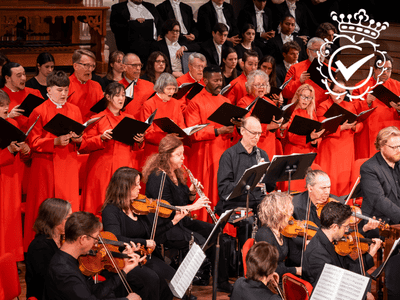
CONCORA performs three of Bach’s choral cantatas as part of the third annual BACHtoberfest Weekend: Wer da gläubet und getauft wird, Schau, lieber Gott, wie meine Feind, and Der Herr denket an uns. Enjoy the opportunity to hear Chris Shepard’s professional choral ensemble that’s praised as one of New England’s “premier musical forces”; CONCORA regularly performs Bach’s cantatas as well as other praised vocal works, and are an annual staple at BACHtoberfest Weekend.
Program
J.S. Bach – Bleib bei uns, denn es will Abend warden (BWV 6)
J.S. Bach – Brich dem Hungrigen dein Brot (BWV39)
J.S. Bach – Herr, wie du willt, so schick’s mit mir (BWV73)
Please note: program, venue, time, and artist are subject to change.
BACHtoberfest Weekend 2026 Program
You might also like…
The Complete Bach: Cantatathon 2027
March 21, 2027 4:00 pm



CONCORA
Connecticut Choral Artists presents choral music at the highest level, from the Baroque to the present day. CONCORA programs challenge, excite, educate, and inspire audiences across New England.
Under the direction of Chris Shepard, Artistic Director, the ensemble’s versatility is displayed in its wide range of repertoire and in the crafting of ensembles from among the choir’s roster of singers.
CONCORA has been praised as “one of the premier musical forces in the state,” “one of our region’s priceless musical assets,” and “a model of choral artistry.”
Choral music has the power to cross cultural boundaries and to move hearts; CONCORA’s mission to reach a broad and diverse audience extends not only to the choral aficionado, but also to those who may be touched by the beauty of the choral art for the first time.
BWV 6: Bleib bei uns, denn is will Abend werden
Of Bach’s several Easter cantatas, BWV6 is particularly perplexing in its subdued and intense Affekt. The Gospel reading for Easter Monday 1725 was the story of the two disciples walking from Jerusalem to Emmaus. They think the story is over—Jesus has died and they are bereft. As they are mulling over the events in Jerusalem, the risen Christ walks with them, but they don’t recognize him. The anonymous librettist chooses their words to Jesus as his text’s starting point: “Stay with us, for it is evening and the day is now far spent.” This becomes the prayer in the opening chorus, a moving sarabande that is reminiscent of Ruht wohl from the St John Passion, suggesting that the disciples’ minds are still at the foot of the Cross.
There are some extraordinary musical effects in this opening chorus. The plaintive tone of the oboe section, including the English horn, provides most of the melodic material which is later taken up by the choir. The strings pulse on repeated unison quavers, adding a sense of anxiety to the mourning figure. The choir implores God to “stay with them” in series of short phrases which build in intensity. The middle section is completely different, with Bach reverting to the Lutheran motet style that he often uses to refer to the “old order”—in this case, Jesus’ death before the disciples acknowledge the resurrection. Bach builds an ever-shifting collage from three musical elements: a descending, lyrical setting of “denn es will Abend werden”; a more detached phrase for “und der Tag hat sich geneiget”; and an almost trumpet-like plea on three long repeated notes for “bleib bei uns.” There is no primacy among the parts for this section; instead, the themes are interwoven in imitative counterpoint until an impassioned climax featuring a unison choral “bleib bei uns” before returning to the original sarabande.
In the internal recitatives and arias, the librettist pursues the juxtaposed themes of the darkness of sin and the power of God’s light to dispel the darkness. In the alto solo, the singer prays that God will “remain our Light’, while the deep-voiced English horn (originally corno di caccia) plays the role of the darkness that “breaks in.” Atypically, the English horn never plays the full ritornello after first introducing it; instead, representing the “breaking in,” the instrument plays fragments of the ritornello, constantly interrupting the singer’s prayer.
The prayer continues in another form in the following chorale, with the soprano singing two verses of a hymn that was sung in church the same day that this cantata was performed. Like the alto in the previous solo, the soprano asks for God’s presence—through his Word and sacraments—in the midst of the world’s trials. The instrumental solo was originally written for the violoncello piccolo, whose smaller size and fifth string made the highly figured part much easier to play than on the cello. Just as with the English horn solo, one gets the impression that the instrument represents the activity of the world, as against the steadfastness of God’s help as represented by the unadorned soprano chorale. Bach must have thought highly of this movement; he arranged it for organ in the final years of his life, where it became one of the Schübler Chorales, BWV 649.
We descend even further into darkness in the bass recitative and tenor aria that follow. The bass lays the blame at our feet: with tortured harmonies and a huge range, he asserts that darkness has descended because we have not walked in righteousness. The remedy? Bach hides the answer in the opening motto of the tenor aria: with the ascending G-D and descending Bb-F#, he creates a musical cross, telling the believer that it is the cross of Jesus that will bring light. The first half of the sober tenor aria explores the wrenching chromaticism of the cross until the light appears in more lyrical writing and major tonalities in the B section, in which the tenor prays, “let the light of thy Word shine more brightly to us.” Since we cannot return to sinfulness, Bach closes the aria with the ritornello, rather than using the characteristic da capo form of the Leipzig arias.
Throughout the cantata, Bach and his librettist seem to making the point that the resurrection is meaningless as an event unless the believer takes hold of it in a personal way. It may seem odd to have such dour music for Easter, but this is the Lutheran way—and indeed, it is the core message of the Reformation: faith is a personal, rather than corporate, decision. The cantata closes with the corporate prayer: “show your power” and “preserve your church”. This is Easter as only a Lutheran could conceive of it.
BWV 73: Herr, wie du willt, so schick’s mit mir
In the Gospel reading for the third Sunday after Epiphany, Matthew 8:1-13, a leper approaches Jesus and says “If thou wilt, thou canst make me clean.” Bach uses the opening phrase of the Kaspar Bienemann hymn text – “Lord as thou wilt”—as a unifying motive throughout the movement. The strings introduce the motto in short staccato phrases, providing a punctuated ostinato-like accompaniment to the sequential scalar oboe phrases. The chorale is sung homophonically by the choir in between solo recitatives by all four soloists. The singers accept God’s will, despite the fact that they can so seldom understand why they must endure difficulties. The movement ends with the choir repeating three times the head-motive, “Lord, as thou wilt.” Despite the resigned nature of the text throughout, Bach establishes a very unsettled mood for the movement. Although the choir sings that they have accepted God’s will, they clearly have reservations. In a sense, the oboes fight with the strings in the same way that the singers struggle to believe what they are singing. Even the last chord that the choir sings, a high-position seventh chord with a suspension, makes it clear that the singers have not truly come to terms with their fate.
The tenor aria that follows is the sunniest movement in the work. As he so often does, Bach uses a walking bass to represent the believer’s pilgrimage and search. In this case, the tenor is asking to receive the spirit of joy, even though he is a “spiritual invalid”. In the middle section, Bach uses syncopations and descending chromaticism to illustrate the words “falter” and “fainthearted.” By contrast, the A section, which repeats in this da capo aria, is seen as more confident and forward-moving.
The anonymous librettist deals directly with the believer’s obstinacy in a short but very difficult recitative. This is Bach at his most complex, with diminished harmonies that shift quickly beneath a solo with large, angular leaps on words such as “perverse”, “defiant” and “despondent”. We begin to see the true resignation that was missing from the opening chorus in the aria which follows the recitative. Again we hear those opening words, “Lord as thou wilt”, but this time in a more lyrical motto which is then repeated sequentially. The text acknowledges that God’s will eventually leads to death; in a wonderful example of word-painting, the singer invites the “bells of death” as the pizzicato strings play the part of the bells themselves. The string parts feature much canonic interplay, as if confirming and strengthening the singer’s growing resolve.
This 1724 cantata—shorter than many of Bach’s sacred cantatas—finishes with a chorale of praise, proclaiming that God’s will is to lead his church to the Kingdom of Heaven. The text and melody are taken from the hymn Von Gott will ich nicht lassen.
BWV 39: Brich dem Hungrigen dein Brot
This is among the most beloved of all Bach cantatas, not least because of its extraordinary, far-ranging and deeply expressive opening Chorus. Unlike so many of the thornier, more deeply theological cantata texts, the contemporary listener can instantly relate to this text: feed the hungry and clothe the naked. Although the text comes from Isaiah 58:7-8, the Gospel reading for the day was the parable about Dives and Lazarus. Dives, the rich man, ignores Lazarus, the poor man covered in sores. When they die, Lazarus is taken into heaven, but Dives goes to Hell, where he begs for a drop of water to slake his thirst. The message of the cantata is clear: just as God has given us freely of his bounty, we should help our neighbors in order to repay God’s goodness towards us.
This cantata was written for Trinity Sunday in 1726—the third anniversary of Bach’s arrival in Leipzig. And what a three years it had been! In his first year, Bach either repurposed or wrote a new cantata for every Sunday and feast day, and in his second year, he wrote an extraordinary encyclopedia of cantatas for each week that used as its basis a Lutheran chorale. In the third year, Bach’s vocal output had featured more solo cantatas and had been more experimental than the highly structured chorale-cantatas of the second year. At the start of his fourth year in Leipzig, it is not difficult to imagine Bach feeling at least somewhat fatigued by his extraordinary work rate in those first few years, while also having become disillusioned with church, town, and school politics in Leipzig. So it is understandable that he would relax his self-imposed writing regimen and begin to incorporate the cantatas of other composers, especially his cousin Johann Ludwig Bach, who was Kappellmeister for the court in Meiningen. J.S. Bach didn’t just program some of his cousin’s Meiningen cantatas, he also set some of the court’s librettos—possibly written by Duke Ernst Ludwig—himself. BWV39 is one of those settings of a Meiningen libretto, notable for its division into two parts. (We will omit the hour-long sermon that would have occurred between the cantata’s two sections!)
We find in the opening chorus of BWV39 a composer at the absolute height of his powers. Imagine the vast trove of techniques at his disposal after writing a cantata each week for three years: already the master of so many different forms of vocal music when he arrived in Leipzig in 1723, those skills had only become more honed in the intervening three years. Bach draws on a number of these techniques in setting this broad-canvassed chorus, taking the listener from the misery of the hungry to the vision of God’s glory, the reward for those who help the poor and needy. The first section is a modern concerto-style setting of the command: break bread with the hungry, and clothe the naked. The opening orchestral ritornello is audacious in its unremitting repetition of the pairs of eighth notes that move continually between the recorders, oboes, and strings. Is this the relentlessness of hunger? The breaking of the bread? Is it the same reference to the cross found in the similar opening to the Crucifixus of the B Minor Mass, reminding us that we need to humble our spirits in order to help the humble of body? Whatever Bach’s meaning is, the first moment of the light shining through comes with the word führe—to “lead” the hungry into the house. The music shifts abruptly for the imperative to clothe the naked; here, Bach seems to be emphasizing the text “and don’t recoil from your own flesh,” with almost angry, accented homophonic passages.
After that entire opening section, which in another cantata might have been a complete movement, Bach shifts entirely to a different Affekt. The Isaiah text promises that “your light shall break forth as the dawn”—God’s reward for the righteous. Here, Bach sets an ebullient, technically brilliant fugue beginning in the tenors and spreading throughout the choir—though the orchestra still includes the same sense of atomized, ostinato-style eighth-note pairs throughout. This is a fascinating shadow of that insistent opening ritornello: is Bach suggesting, as Jesus said in Matthew 26:11—“ye have the poor always with you”? Whatever its meaning, in the second iteration of the fugue to a new text, “and the glory of the Lord will embrace you”, the hammering ostinato is stilled, and this monumental movement ends with a glimpse of God’s glory.
After having established the imperative to feed the hungry, the inner solo movements explore in different ways the theme of how God’s abundance for his people should be reflected in his people caring for each other. After the bass makes the point in his recitative that whatever God gives us remains his, the alto sings a minuet-like trio with the oboe and solo violin. In this aria, she sings that by imitating God in our generosity on earth, we get a foretaste of heaven. The salient musical image that Bach focuses on is the scattering of the seed of blessing. He does this with rolling sixteenth-note patterns that are shared between the two instruments throughout the movement. Against this, the singer’s line is quite straightforward, except for one thrilling moment when she sings an extended melisma for the word “scatter”, echoing the instruments.
The bass aria that begins the second part is a mirror of the opening cantata’s instruction to do good and to share. But what a completely opposite compositional approach! This rather dour movement is set for bass soloist and continuo only. Rather than having a long melody, the opening motive from the continuo recurs throughout the rather short movement. This gives the movement a coherence and insistence that feels like a command directly from a biblical prophet. In contrast, the following beautiful pastoral soprano aria, accompanied by a pair of recorders, is melodic and expressive. It is a reflection of the earlier message that everything we have is a gift from God; here the soprano essentially sings that we cannot give God anything that he has not already first given us. The choice of the lilting meter and the recorders, which often represent simplicity and humility in Bach’s cantatas, places this movement spiritually in the manger, even though Christmas is six months away from Trinity Sunday. But that is the message of the Nativity, after all—that God’s true gift for His people is His Son.
In the accompanied alto recitative, the singer pledges that he will give his very spirit to God, expressed through helping his neighbor and being of service to the poor. This remarkable cantata closes with a verse of a chorale that echoes the Sermon on the Mount—blessed are they who help others.
– Chris Shepard
WAMS Works
6 Institute Rd, Worcester, MA 01609
The Sarah Wyman Whitman Gallery at WAMS Works is an intimate, flexible venue used by Music Worcester for small ensembles and solo performances.
SEATING
Seating is on moveable chairs in the former sanctuary of the United Congregational Church, now the Sarah Wyman Whitman Gallery at WAMS Works. The space holds 200-300 audience members. All Music Worcester concerts here are General Admission. The space is fully accessible for those with mobility concerns. Read more about accessibility here.
PARKING
A dedicated, free parking lot for WAMS Works is located on Grove Street, across from the building.